
Elmhurst Previous-Resident Sources by Era
The right first source depends on the period. Current parcel and recorder tools work best for recent title. Directories, maps, census schedules, and newspapers add the people and place context that deeds cannot supply. For early Elmhurst, regional and county records may be more useful than city files.
| Source | Years it covers | Where held | What it shows |
|---|---|---|---|
| Recorder documents | Online from March 16, 1961 | DuPage Recorder portal and counter | Deeds, parties, dates, images, liens, and plats |
| City and telephone directories | Back to at least 1909 | Elmhurst Public Library and History Museum | Name and address crosswalks, phone or business clues |
| Sanborn and city maps | Selected years from 1885 onward | Elmhurst History Museum | Street, lot, structure, subdivision, and annexation context |
| Federal census | Public schedules through 1950 | Library genealogy databases and federal archives | Households under the 72-year release rule |
| Local newspapers | Selected runs from 1885 onward | Library and Museum indexes or microfilm | Obituaries, sales, events, businesses, and address mentions |
| County historical series | Series vary, some from 1839 | IRAD at Northern Illinois University | Vital, naturalization, minutes, and court-related clues |
Start with deeds for a post-1961 owner chain. For an early-twentieth-century household, start with a directory year and map, then use a census or newspaper to test the names.
Start Elmhurst Previous-Resident History
The DuPage property portal resolves the present address to a PIN, owner, situs and mailing fields, legal description, tax year, and transfer or conveyance tabs. Keep situs and billing apart. A mailing match can be useful, but it does not prove that the tax-roll owner occupied the house.
The transfer view can record sale date, sale price, document type and number, grantor, grantee, recorded date, sales type, and state validity code. It is an index lead, not a certified deed and not proof that a household moved on that date.
The official property conveyance example shows the fields to capture before going to the Recorder.
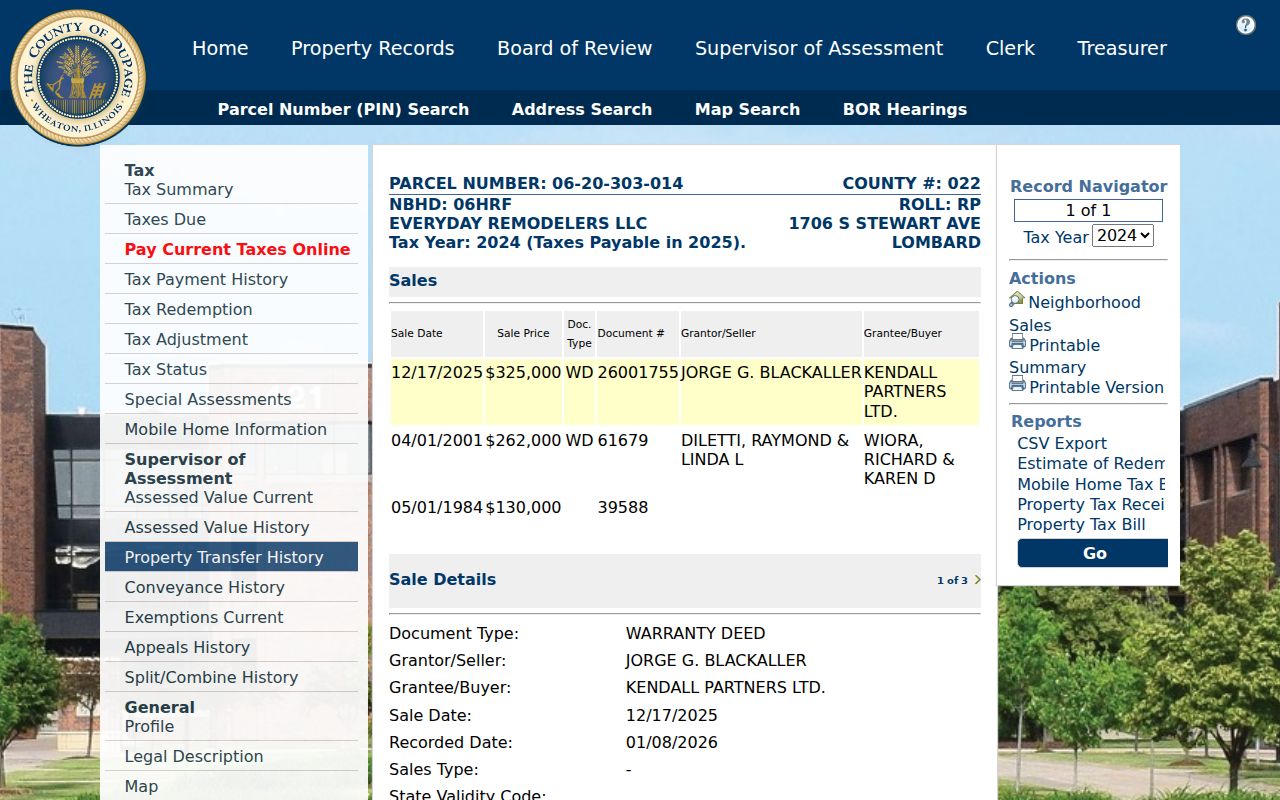
The screen makes document number and party roles visible, which helps keep the backward trail tied to the correct instrument.
A parcel split or combine can replace the PIN. When that happens, follow the assessor's split/combine history and compare recorded plats. Condominium creation, annexation, and a new subdivision can also alter the legal description. Carry both the old and new identifiers forward in the research ledger.
Trace Elmhurst Previous Owners
A chain of title is the sequence of recorded interests in the same parcel. Begin with today's parcel profile, then walk backward from the latest deed. Match the PIN, subdivision, lot, and legal description each time. A street address alone can break when numbering, city labels, or parcel shapes change.
- Save the current PIN, owner spelling, situs, billing address, legal description, and transfer rows from the assessor.
- Find the latest purchase deed in the DuPage Recorder search by PIN, address, document number, party, or date.
- Record instrument type, date, number, grantor, grantee, and legal description. Do not count a mortgage or release as a transfer.
- Search the seller as an earlier grantee. Widen the date range and test trust or company spelling when needed.
- Repeat to March 16, 1961, then ask Recorder research staff about earlier office holdings and consult local maps, directories, or IRAD.
- Grantor
- The party transferring an interest in a recorded instrument.
- Grantee
- The party receiving that interest.
- Chain of title
- The linked sequence of instruments affecting the same property.
- Legal description
- The recorded land description, often stronger than a changing street address.
The live grantor and grantee form displays the party, property, document, type-group, and date routes.
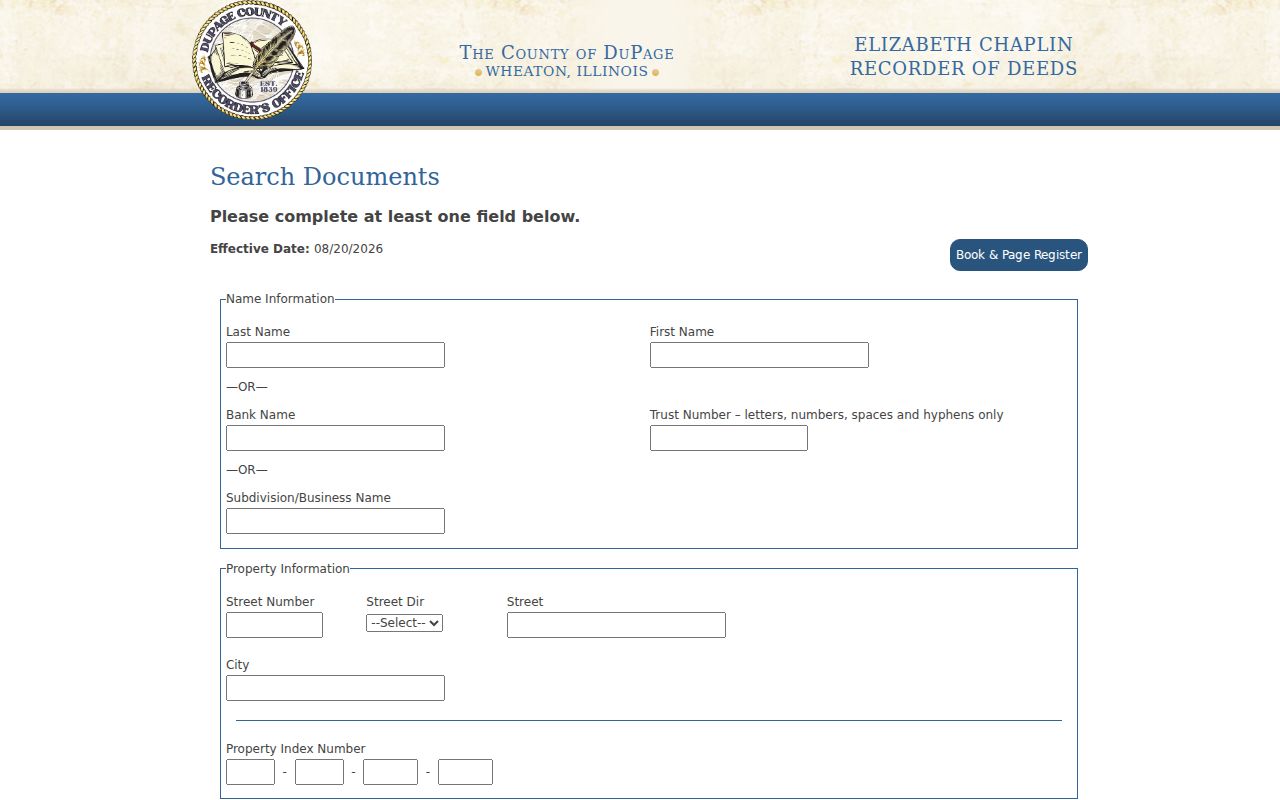
Use those controls to move one verified transfer at a time, rather than searching every matching surname at once.
Earlier Elmhurst Resident Deed Trails
The Recorder's online indexed documents and digital images begin March 16, 1961. The website extends the public terminals at the Recorder office. Earlier deed-image coverage was not verified in the county sources, so the honest fallback is the research counter at 421 N County Farm Road in Wheaton, telephone research at 630-407-5401, or a focused office request.
Local sources can bridge context without replacing title. The History Museum has maps, directories, manuscripts, photographs, and municipal records. The Library has directory and newspaper holdings. IRAD lists DuPage historical series. Cite an earlier map or directory as evidence of a building or named occupant, not as a recorded ownership transfer.
For each offline request, provide a full name, approximate year, record type, parcel description, and any known instrument number. IRAD does not take email research requests, and its series inventory is only a catalog of what may be held. Confirm copy costs and visit rules with the custodian before ordering or traveling.
Note: A gap before the web start calls for an office or archive search, not an invented first-owner date.
Place Elmhurst Residents on Parcel
Owners are only one part of a house history. The Elmhurst Public Library local-history collection describes city and telephone directories reaching back to at least 1909. Read a directory by street and number where possible, then preserve the title, year, page, printed name, role, phone, and any business or occupation note. Exact run-by-run years and a public sample page were not found.
Pair a directory close to a deed date with the nearest public federal census year. Census schedules through 1950 are generally public under the 72-year rule, while the 1890 schedules were destroyed. Use household names and relationships to test a directory entry, but account for enumeration order and address variation.
- Choose a deed or transfer date and inspect the directory year before and after it.
- Record each printed role exactly, including subscriber, boarder, owner, or business where shown.
- Find the address in the closest available census through a Library genealogy database.
- Compare names, ages, kin ties, and street order, then mark conflicts instead of forcing a match.
The collection details belong to the Elmhurst city directory page; the backward trail uses only the years needed for one address.
Map Elmhurst Previous-Resident Addresses
The History Museum's maps include Elmhurst in 1885, 1910, 1933, 1949, 1974, and 2023, plus a subdivision map, annexation map, residential-construction map, and Sanborn fire-insurance maps for 1918, 1924, and 1965. Other verified Sanborn years include 1893, 1898, 1909, and 1932. These maps can establish a footprint, lot, use, or street grid, though they may not name previous residents.
Older records may call the place Cottage Hill before its 1870 renaming, an Elmhurst village after 1882, or the city after 1910. No formal old-to-new house-number list was located. If an address jumps, test the old place label, subdivision, lot, block, nearby owner, and map position. Ask the City Clerk about ordinances or use the Museum's street-history question form.
A Sanborn sheet can reveal whether a structure existed, changed use, or sat on a differently shaped lot. It cannot identify every past resident. Pair the map with a dated directory, census line, deed, or newspaper citation before connecting a name to the building.
Elmhurst Resident Trail Meets Fire Gap
A real local source gap affects address research. The Library reports that fire losses removed the Elmhurst Press run from 1899 through 1918 and from December 1922 through December 1928. That absence does not show that a person, sale, death, or building event never occurred.
Use the Elmhurst Enterprise, Wheaton Illinoian, other surviving local runs, directory years, cemetery or funeral files, deeds, census schedules, maps, and Museum manuscripts around the missing span. For later years, the Museum's Pastfolio covers Elmhurst Press material for 1918 to 1921 and 1929 to 2008, while Library databases add several modern newspaper runs.
Search both the address and the names from the deed chain. A social notice may omit a house number, while a sale or permit item may omit a full personal name. The two searches can meet through a street, subdivision, school, church, or business.
Confirm Elmhurst Past Residents
Newspapers and probate can close a trail when a resident died, an estate transferred property, or relatives appeared in a notice. Search an old owner and exact address in obituary, sale, permit, business, school, church, and civic references. Probate is a DuPage Circuit Court file, not a general vital-record index, so use the Circuit Clerk counter or public case path when a specific estate is known.
The Illinois Department of Public Health genealogy route explains state access thresholds and pre-1916 referrals. Original records have statutory inspection thresholds, while genealogy-copy rules differ. Certified marriage and death records for DuPage events route through the County Clerk under eligibility rules.
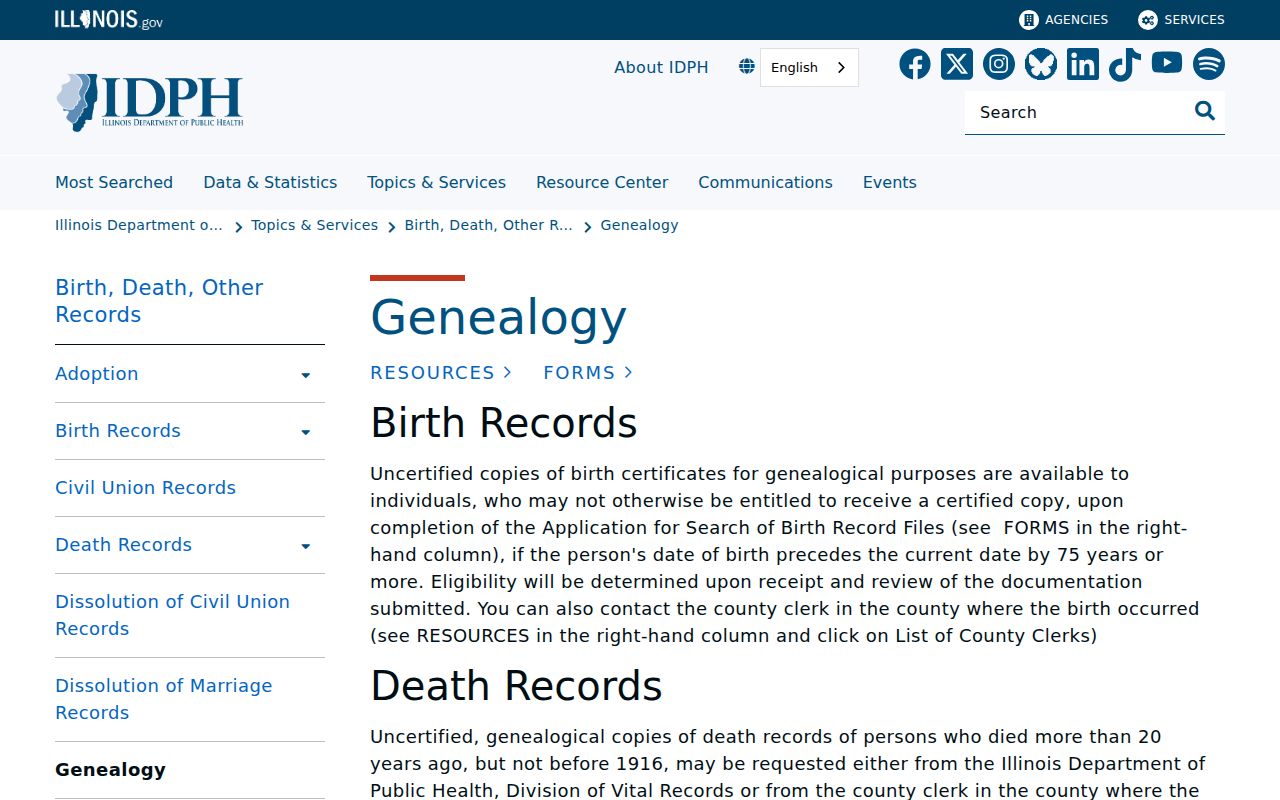
The guidance helps distinguish a genealogy search from a restricted certified copy request.
Keep Elmhurst Resident Roles Distinct
A tax-roll owner may be a trust, company, or person who gets bills elsewhere. A deed party may be a trustee, lienholder, or beneficiary. A directory may name a phone subscriber, former occupant, boarder, owner, or business. None of those roles should be silently changed to resident.
Finish with a source ledger: record year, custodian, exact URL or shelf, page or image, owner or occupant wording, and unresolved gap. Mark parcel splits, combines, annexations, trusts, and address variants. That record lets another researcher test the same chain.
Lawful use. Research Elmhurst previous residents for house history, genealogy, estate work, and personal curiosity. Never use the trail to stalk, harass, track, intimidate, or harm a living person.